Haitian Creole and French Document Translation in Florida
A Haitian birth certificate is usually in French. The affidavit stapled to it may be in Creole. The person who needs both translated for a USCIS filing or a Florida court speaks Creole at home and was schooled in French, and the translator they hire needs to read both without guessing. This guide covers what a Haitian document actually looks like, what the translation must carry to be a certified translation, and where the work goes wrong.
Why Haitian Documents Are a Two-Language Problem

Haitian Creole is the language spoken by essentially everyone in Haiti; French is the language of the state, the courts and the schools. Article 5 of Haiti's 1987 Constitution puts it in one line: all Haitians are united by a common language, Creole, and Creole and French are the official languages of the Republic. In practice that means the formal record of a Haitian life is written in French and the life itself is lived in Creole.
So a single filing from a Haitian family can arrive in three states at once. The civil records, birth, marriage, death, are in French, often in formulaic legal French with abbreviations particular to Haitian registries. A sworn statement from a relative, a church letter, a receipt, a text message exchange or a handwritten note is in Creole. And a good number of documents mix the two: a French form filled in by hand in Creole, or a French heading over a Creole body.
A translator working from French alone can produce a clean, confident translation of the first category and a wrong one of the second, and nothing on the page will show which is which. That is the specific risk with Haitian documents, and it is the reason this guide exists.
What a Haitian Birth Certificate Actually Is
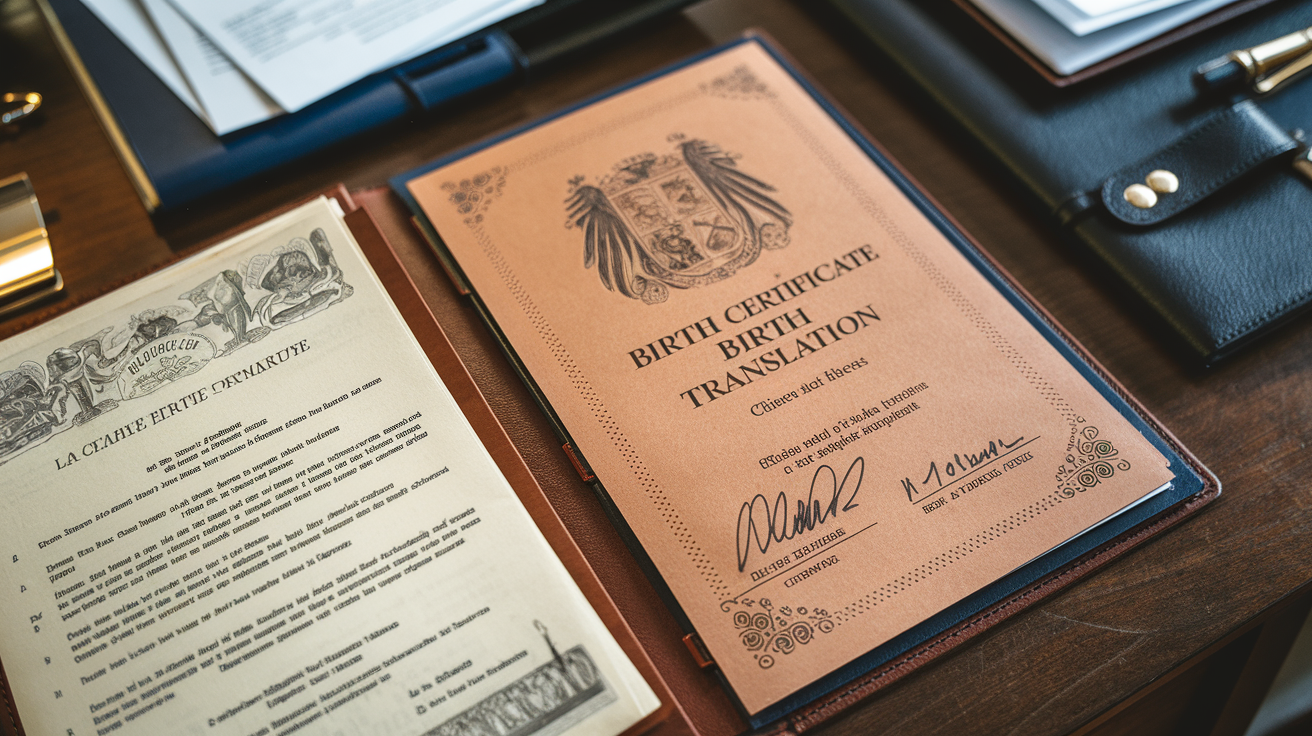
Most of the confusion about Haitian civil documents comes from one fact: the original and the copy are different documents with different names, issued by different offices. Consider a typical adjustment-of-status file, which may contain both, and a translation that labels them wrongly invites a request for evidence.
The U.S. Department of State's reciprocity schedule for Haiti, which is what consular officers use to judge Haitian civil documents, sets the terms out plainly.
U.S. Department of State, Haiti reciprocity schedule and civil documents →
Acte de naissance
An acte de naissance is the original Haitian birth certificate, issued only once by the regional civil registry office when the birth is first declared. It is a register entry, not a card, and it is in French.
Extrait des Archives
An extrait is a certified extract of the register entry, issued by the National Archives of Haiti on request, generally once a year has passed since the declaration. It carries the Archives director's signature and is the document most applicants abroad actually hold.
Attestation
An attestation is a short confirmation that a birth was registered, available for recent registrations. The State Department treats an acte with an attestation as an alternate document only within a narrow window after registration.
What USCIS Requires of the Translation

A certified translation is a complete English translation of a foreign-language document together with a signed statement from the translator that the translation is complete and accurate and that the translator is competent to translate from that language into English. That is not a house definition. It is the federal regulation. Under 8 CFR 103.2(b)(3), any document containing foreign language submitted to USCIS must be accompanied by a full English translation that the translator has certified as complete and accurate, and by the translator's certification that he or she is competent to translate.
Three things follow from that wording. The translation has to be full, so stamps, seals, marginal notes and the registrar's abbreviations are rendered too, not summarised. The certification has to come from the translator, which is why a family member who speaks both languages is a poor choice: the person certifying competence should not also be the beneficiary's cousin. And the regulation asks for a certification, not a notarization. A notary witnesses a signature; a notary does not vouch for a translation. Having the certification notarized does no harm, but it does not replace the certification and it is not what the rule requires.
Apostille, Legalization and What a Haitian Document Cannot Carry
An apostille is a standard certificate, issued under the Hague Convention of 5 October 1961, that authenticates the origin of a public document for use in another country that is party to the Convention. Haiti is not a party. The Hague Conference's status table for the Apostille Convention does not list it, so there is no Haitian authority that can issue one, and a request for an apostilled Haitian birth certificate cannot be met.
That matters less than people fear. USCIS asks for the translation certification described above; it does not ask for an apostille on the foreign original. Where another authority, a Florida court, a school, a foreign ministry, wants the Haitian original authenticated, the route is legalization through the Haitian consulate, which is a separate step from translation and is arranged by the document's owner. The translation is prepared from the document as issued, and the certificate of accuracy covers the translation, not the authenticity of the original.
Where Haitian Translations Go Wrong

After translating Haitian records for immigration and court use since 2009, the failures repeat. None are exotic, and all are cheaper to prevent than to explain to an adjudicator.
The French translator meets a Creole paragraph
A translator competent in French reaches a handwritten Creole note on the back of a form, or a Creole affidavit in the same bundle, and either skips it, marks it illegible, or guesses from the French cognates. Creole spelling is its own system, and a French reading of it produces confident errors.
Solution: The translator assigned to a Haitian bundle reads both languages. Where a passage is genuinely illegible, the translation says so at that point, in brackets, rather than smoothing over it. Nothing is skipped on the grounds that it is informal.
The name is spelled three ways
The acte spells a surname one way, the extrait another, and the passport a third. Haitian registries, French orthography and later anglicisation each leave a mark. An adjudicator reading three spellings sees three people.
Solution: Names are transcribed exactly as they appear on each document, never harmonised, and the translation can carry a translator's note that the variants refer to the same person as shown by the other identifiers on the record. Harmonising names is the applicant's attorney's job, with evidence; it is not the translator's.
The extrait is translated as the original
The extract from the National Archives is labelled in the translation as a birth certificate, with no mention that it is an extract, or the reverse. The filing then appears to contain a document it does not.
Solution: The document type is translated as what it is: Extract from the Archives, Birth Certificate, Attestation. The issuing office, the signature block and the registry references are rendered in full so the reader can match the translation to the reciprocity schedule.
Dates, kinship and formulae
Haitian registry French runs to set formulae (the declarant, the witnesses, the age in years at declaration) and kinship terms that do not map one-to-one onto English, while dates in Creole statements may be written in a form a non-Creole reader misorders.
Solution: The translator keeps the formulae as the register has them, renders dates unambiguously in the English, and uses the kinship term the document uses rather than a tidier English one. The goal is a translation an officer can lay beside the original and follow line by line.
Haitian Documents and Interpreters in Florida Courts
When a Haitian document is an exhibit in a Florida proceeding rather than a USCIS filing, the same certified translation is what counsel attaches, and the same two-language issue applies to the witness. Florida regulates spoken-language court interpreters under the Florida Rules for Certification and Regulation of Spoken Language Court Interpreters, which set out the designations an interpreter may hold. Rule 14.100 defines a certified interpreter as one who has completed all the certification requirements, a language skilled interpreter as one who meets the requirements in a language for which there is no state certifying examination, and a provisionally approved interpreter as one who has passed the oral exam at a lesser qualifying level.
The practical point for a Haitian Creole matter is to ask which of those designations the interpreter holds in Haitian Creole specifically, not in French, and to check it. The Florida Courts publish a searchable directory of designated interpreters by language. A Creole-speaking witness interpreted through a French interpreter is the courtroom version of the document problem above, and it is caught the same way: by naming the language precisely at the point of booking.
Our Haitian Creole interpreter and translator page covers court, medical and USCIS interpreting in Orlando and by video nationwide; the deposition guide covers the rule that applies when counsel retains the interpreter.
Translating Haitian Documents With MVP Translations
MVP Translations translates Haitian civil records, affidavits, court documents, school and medical records and personal correspondence from French and Haitian Creole into English, with a signed Certificate of Accuracy on every certified translation, for USCIS filings, Florida courts, schools and employers. Every translation is done by a person, never by machine translation, reviewed before delivery, and delivered in a form that can be laid beside the original. Milton Palacio, the founder, is a Florida Certified Court Interpreter and has run the company from Orlando since 2009, serving clients across Florida and nationwide.
To get a quote, send us a scan or clear photo of each document, front and back, and tell us what it is for. If the file mixes French and Creole, say so; if you are not sure, send it anyway and we will tell you. Call (888) 546-7247 or use the form below. Our certified translation services page covers document types, turnaround planning and the certificate itself.
Frequently Asked Questions
Civil records in Haiti, including the acte de naissance and the extrait issued by the National Archives, are drawn up in French, because French is the administrative language under Haiti's Constitution. Personal statements, letters and handwritten additions are often in Creole, which is also official. A Haitian bundle commonly contains both, and the translator needs to read both.
Under 8 CFR 103.2(b)(3), the translation must be a full English translation, certified by the translator as complete and accurate, with the translator's certification that he or she is competent to translate. MVP Translations supplies that as a signed Certificate of Accuracy with every certified translation.
The USCIS regulation asks for the translator's certification, not a notarization. A notary witnesses a signature and does not vouch for the translation. If a particular court or agency asks for a notarized certification, that can be arranged, but it is in addition to the certification, not a substitute for it.
No. Haiti is not a party to the Hague Apostille Convention, so no Haitian authority issues apostilles. USCIS does not require one for the foreign original. Where another authority wants the original authenticated, the route is legalization through the Haitian consulate, arranged by the document's owner.
For a document that is entirely in formal French, possibly. For a Haitian bundle, usually not safely, because Creole passages, Creole spellings of names and places, and mixed French-Creole forms are read wrongly by a French-only translator. Ask whether the translator reads Haitian Creole as well as French before you send the file.
A scan or clear photo of every page, front and back, including stamps and anything handwritten, and a note of what the translation is for. We quote per document after seeing it. Request a quote through the form or call (888) 546-7247.