Brazilian and European Portuguese Document Translation in Florida
Brazilians arrive in Florida with a concept of official translation that does not exist in the United States, and Americans ask Portuguese speakers for a kind of translation that does not exist in Brazil. The two systems use similar words for different things. This guide sorts out which Portuguese your document is in, what a certified translation is here, what a tradução juramentada is there, when an apostille enters the picture, and where the translations we are asked to fix went wrong.
Which Portuguese Is Your Document In?

Brazilian Portuguese is the standard used in Brazil, by far the largest Portuguese-speaking population and the source of most Portuguese documents that reach Florida. European Portuguese is the standard used in Portugal, and with regional differences in Angola, Mozambique, Cabo Verde and the other Portuguese-speaking countries. A speaker of one reads the other without difficulty. A translator working on a legal document cannot afford to.
The two standards diverge most in the places a civil or legal document lives. For example, the Brazilian birth record names the cartório and the registrar's book, folio and term; a Portuguese one names the conservatória. Brazilian identity documents carry a CPF and an RG; Portuguese ones a NIF and a cartão de cidadão. The month, the addressing of parties, the formula for a notarised copy and the names of the courts are all different. A translator fluent in one standard and guessing the other produces an English that is fluent and wrong.
So the first question we ask about any Portuguese document is where it was issued. It is not a formality; it decides which translator is assigned.
Portuguese interpreters and translators in Orlando →
Brazilian Portuguese documents
Brazilian Portuguese is the written and spoken standard of Brazil. Civil documents come from a cartório de registro civil, identity from the RG and CPF system, and legal documents from state and federal courts whose names, formulae and abbreviations are Brazil's own.
European Portuguese documents
European Portuguese is the written and spoken standard of Portugal, with close relatives in the African Portuguese-speaking countries. Civil documents come from a conservatória do registo civil, identity from the cartão de cidadão and NIF, and legal formulae and institutional names differ from Brazil's throughout.
Tradução Juramentada Is a Brazilian Concept, Not an American One
A tradução juramentada, or sworn translation, is a translation made in Brazil by a tradutor público e intérprete comercial, a public translator registered with the commercial registry (Junta Comercial) of a Brazilian state. Brazil's Lei 14.195 of 2021 governs the office. Under article 22 the candidate must pass an aptitude examination, under article 24 a registered public translator may practise in any state and the Federal District, and under article 27 no translation has public faith (fé pública) in Brazil unless a public translator made it. That is why a Brazilian authority will not accept a translation into Portuguese from anyone else.
The United States has no equivalent office. There is no federal or Florida register of sworn translators, and no translation here carries public faith. What a U.S. agency or court asks for instead is a certified translation: a full English translation together with the translator's signed certification that it is complete and accurate and that the translator is competent to translate. For USCIS, that is the regulation at 8 CFR 103.2(b)(3). The certification is a statement by the translator, not a status conferred by the state.
Consider the two directions. A Brazilian who brings a tradução juramentada of a birth certificate into English has a translation by a credentialed professional, but if it lacks the English certification of completeness, accuracy and competence, it is not yet what the regulation describes. An American who needs a U.S. document used in Brazil, a diploma, a power of attorney, a court order, will need a tradução juramentada made in Brazil by a public translator, because nothing a U.S. translator can sign has public faith there. We tell clients which they need before any work starts.
What a Brazilian Civil Document Looks Like

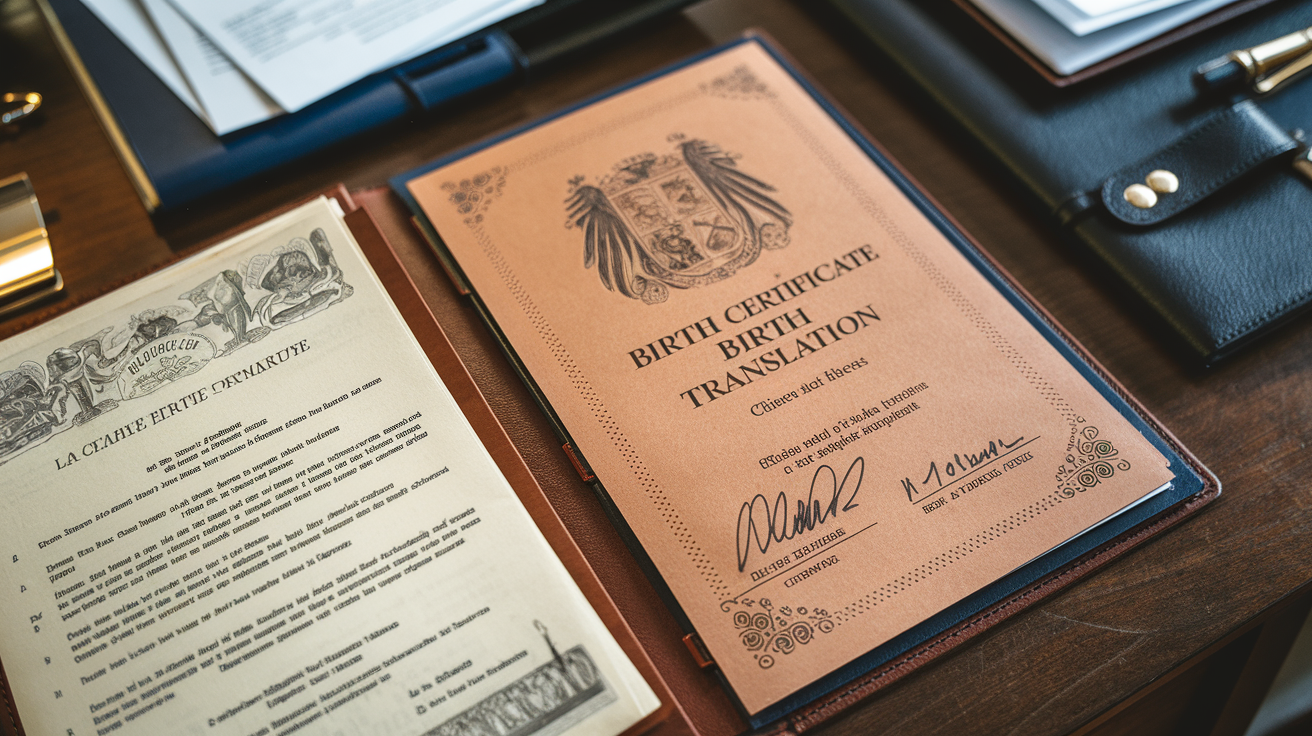
The U.S. Department of State's reciprocity schedule for Brazil, the reference consular officers use, sets out what a Brazilian civil record is. Birth and marriage records come from the Cartório de Registro Civil das Pessoas Naturais, the civil registry office. For a birth registered before 21 November 2017 the document is a certidão de nascimento; from that date onward it is the certidão de inteiro teor, the unabridged record, which carries the same basic information plus fuller birth details and a record of later changes. After a marriage, divorce or name change, the schedule notes, a newer copy with the annotations may be needed, and a missing annotation does not prove that nothing changed.
That last point is the one translators miss. The averbações, the annotations in the margin or at the foot of a certidão, are where the document says the person later married, divorced, changed a name, or was recognised by a parent. An adjudicator comparing the translation with the original will find the annotation on one and not the other.
U.S. Department of State, Brazil reciprocity schedule and civil documents →
Certidão de nascimento
A certidão de nascimento is the Brazilian birth certificate issued by a cartório for births registered before 21 November 2017, in the short form, with the registry book, page and term number.
Certidão de inteiro teor
A certidão de inteiro teor is the unabridged record issued from 21 November 2017, reproducing the full register entry and its annotations. Second copies (segunda via) are issued by the same cartório, and for some states by others.
Averbação
An averbação is an annotation added to a civil record after the fact: marriage, divorce, adoption, name change, recognition of paternity. It is part of the document and is translated in full.
Apostilles for Brazilian and Portuguese Documents
An apostille is the standard certificate under the Hague Convention of 5 October 1961 that authenticates the origin of a public document for use in another Convention country. Brazil acceded in December 2015 and the Convention entered into force for it on 14 August 2016; Portugal has been a party since 4 February 1969. So, unlike a Haitian document, a Brazilian or Portuguese original can carry an apostille, obtained in the issuing country from the authority that country designates for the purpose.
What an apostille is for is the original. It does not certify the translation, and USCIS does not require one for the foreign original at all; its regulation is about the translation. Florida courts, universities and foreign ministries sometimes do ask for it. When they do, the apostille is obtained on the original in Brazil or Portugal, the document is then translated, and the apostille page is translated with it, because it is now part of the document.
Where Portuguese Translations Go Wrong

Portuguese translations get questioned for a short list of reasons. Consider the four below; none of them are about vocabulary in the ordinary sense, and all are cheaper to prevent than to explain to an adjudicator.
The wrong Portuguese
A European Portuguese translator renders a Brazilian court document, or the reverse. The institutions, the procedural terms and the formulae come out as plausible English for the wrong country, and a reader who knows the system notices at once.
Solution: The document's country of issue is confirmed before assignment and the translator assigned works in that standard. Where a document is from a third Portuguese-speaking country, we say so and match accordingly.
The annotations are missing
The averbações at the foot of a certidão, or the stamps and marginal notes on a court filing, are left out as if they were decoration. The translation then describes a person whose marital status or name differs from the one on the original.
Solution: Everything on the page is translated, including stamps, seals, annotations and handwritten additions, and anything illegible is marked as illegible at that point rather than silently omitted.
Names, numbers and dates
Portuguese names commonly carry two or more surnames in an order English readers reverse; numbers use a comma for decimals and a point for thousands; and dates are day-first. A translation that normalises any of these creates a mismatch with the passport or the other documents in the file.
Solution: Names are kept in the order and spelling the document uses, every time. Numbers and dates are rendered unambiguously in English form with the original visible, and the translator's notes explain any convention the reader might otherwise misread.
A sworn translation handed in as a certified one
A tradução juramentada made in Brazil, in Portuguese legal form with a Brazilian seal, is filed with USCIS without the English certification the regulation asks for. The translation may be excellent and still draw a request for evidence.
Solution: We review the Brazilian translation, and where it is sound we add the certificate of accuracy in the form 8 CFR 103.2(b)(3) describes; where it is not, we translate afresh from the original. Either way the filing carries the certification it needs.
Portuguese Documents and Interpreters in Florida Courts
When a Portuguese document is an exhibit in a Florida proceeding, the same certified translation is what counsel files, and the question of which Portuguese applies to the witness as much as to the paper. Florida regulates spoken-language court interpreters under the Florida Rules for Certification and Regulation of Spoken Language Court Interpreters. Rule 14.100 defines a certified interpreter as one who has completed all the certification requirements, a language skilled interpreter as one who meets the requirements in a language for which there is no state certifying examination, and a provisionally approved interpreter as one who has passed the oral exam at a lesser qualifying level. The Florida Courts publish a directory of designated interpreters by language.
For a Brazilian witness, book a Portuguese interpreter and say Brazil; for a witness from Portugal or Angola, say so. The interpreter who is comfortable in both standards will still prepare differently, and the one who is not will tell you. Our deposition guide covers the rule that applies when counsel retains the interpreter, and our Portuguese interpreter page covers court, medical and business interpreting in Orlando and by video nationwide.
Translating Portuguese Documents With MVP Translations
MVP Translations translates Brazilian and European Portuguese civil records, court documents, diplomas and transcripts, contracts, medical records and personal correspondence into English, with a signed Certificate of Accuracy on every certified translation, for USCIS filings, Florida courts, universities and employers, and advises on when a document headed the other way needs a tradução juramentada in Brazil instead. Every translation is done by a person, never by machine translation, and reviewed before delivery. Milton Palacio, the founder, is a Florida Certified Court Interpreter and has run the company from Orlando since 2009, serving clients across Florida and nationwide.
To get a quote, send a scan or clear photo of each page, front and back, tell us the country the document comes from and what the translation is for. Call (888) 546-7247 or use the form below. Our certified translation services page covers document types, turnaround planning and the certificate itself.
Frequently Asked Questions
USCIS requires a certified translation under 8 CFR 103.2(b)(3): a full English translation with the translator's certification that it is complete and accurate and that the translator is competent to translate. A Brazilian sworn translation into English meets that only if it carries that certification in English. If yours does not, we can review it and add the certificate of accuracy, or translate afresh from the original.
The one who works in the standard your document was issued in. Brazilian and European Portuguese differ most in institutional names, legal formulae, identity documents and everyday vocabulary, which is exactly what a civil or legal document is made of. Tell us the country of issue and we assign accordingly.
Not for USCIS, which asks for the translation certification and not for authentication of the original. Some courts, universities and foreign authorities do ask for one. Brazil has been a party to the Apostille Convention since 2016, so an apostille can be obtained on the original in Brazil, and the apostille page is then translated with the document.
It is the unabridged Brazilian civil record issued by a cartório since 21 November 2017, reproducing the full register entry and its annotations. The U.S. State Department's reciprocity schedule names it as the birth document for registrations from that date, and the annotations are where later marriages, divorces and name changes appear, so adjudicators want to see them.
A translation for use before a Brazilian authority needs public faith, which under Lei 14.195/2021 only a public translator registered in Brazil can give. A U.S. certified translation does not carry it. We will tell you that at the outset and, where the document is coming to the United States instead, handle the certified translation here.
A scan or clear photo of every page, front and back, including stamps, seals and annotations; the country the document comes from; and what the translation is for. We quote per document after seeing it. Request a quote through the form or call (888) 546-7247.